

New Statistics South Africa (Stats SA) data shows inland 93-octane petrol has climbed from 21,1 cents per litre in 1976 to a record R26,52 in May 2026, with global conflicts, a weakening rand and oil crises driving some of the biggest increases.
South African motorists are paying more for petrol than ever before, with the price of inland 93-octane petrol reaching a record R26,52 per litre in May 2026. Data released by Stats SA shows that the fuel price has increased by more than 12 000% over the past five decades.
In January 1976, motorists paid just 21,1 cents per litre for petrol. While the difference is staggering, Stats SA notes that historical prices must be viewed in context, as inflation means money had far greater purchasing power in previous decades.The report, titled A 50-year take on the petrol price, tracks major fuel price shocks since 1976 and highlights the events that drove some of the steepest increases.
One of the biggest fuel crises occurred in 1979 following the Iranian Revolution, which disrupted global oil supplies. In 1985, a sharp depreciation of the rand triggered the largest percentage increase on record, with petrol prices jumping by 39,4% in a single month. Other major spikes followed Iraq’s invasion of Kuwait in 1990 and during the global oil price surge of 2008.
Although recent increases have pushed fuel prices to record levels, Stats SA points out that the April and May 2026 hikes are not the largest South Africa has experienced. When adjusted for inflation, some of the increases during the 1980s were considerably more severe than those seen today. The latest fuel price surge follows a sharp increase announced by government in May, when petrol prices rose by R3,27 per litre due to higher international oil prices, geopolitical tensions in the Middle East and fuel levy-related factors.
According to Stats SA, petrol first exceeded R1 per litre in 1985, broke through the R10 mark in 2008 and reached R20 per litre for the first time in December 2021.
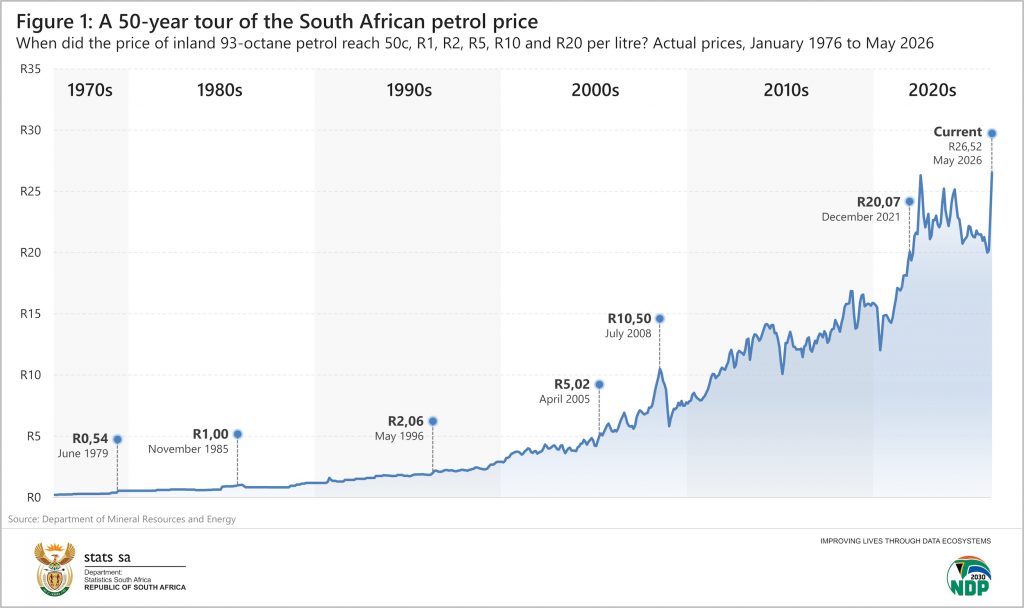
The latest increase has now taken the fuel price to its highest level on record.The record fuel prices are also having a wider impact on the economy. Stats SA recently reported that annual consumer inflation increased from 3,1% in March to 4,0% in April 2026, with fuel price increases identified as the main driver. Higher fuel costs often contribute to rising prices for food, transport and other goods and services.
Five decades after motorists paid just 21,1 cents a litre, South Africans entered June 2026 facing yet another fuel price adjustment. On Wednesday, petrol increased by R1,43 per litre.
Diesel users, meanwhile, received some relief, with prices dropping by R2,62 per litre for 50 ppm diesel and R3,25 per litre for 500 ppm diesel.
For South Africans, rising fuel costs remain a major concern as higher transport expenses often filter through to the prices of food, goods and services across the economy.
Also read:
The braai that burns your budget
Brandstofpryse styg skerp, regering erken berekeningsfout met dieselprys
Nog geen einde in sig vir hoë lewenskostes